
Helping institutions achieve their sustainability goals
Since 2005, we have conducted research, built tools, and organized peer-to-peer learning opportunities for universities, governments, and other sectors working to cut their resource use and emissions.
One ring for every year of our work since 2005. This year's is drawn in green.


Our project management platform is designed to help institutions track, analyze, and report on their sustainability projects.
Green
revolving
funds
A fund dedicated to investing in projects that reduce resource use and utility expenses. Financial savings replenish the fund for the next round of projects.

Building performance standards
Since 2022 we have convened the government staff writing and enforcing these laws. In 2027 they will gather at the first BPS Summit hosted by SEI.

Technical assistance
Through our consulting work, we have helped dozens of institutions design and launch green revolving funds. Our latest is the City of Providence, Rhode Island, which has launched a multi-million-dollar revolving fund with our support.

Resources
Two decades of research, shared freely: step-by-step guides to setting up a revolving fund, surveys of how funds perform, and case studies and sample documents you can adapt. Coming next is a revolving fund guide for local and county governments, commissioned by Lawrence Berkeley National Laboratory and the U.S. Department of Energy.
Coming up, on Zoom
The 2027 BPS Summit
Two half-days where city, county, state and provincial staff share what they have learned designing, implementing and enforcing building performance standards. So far, 27 speakers from 17 jurisdictions have confirmed, including Boston, Denver and Washington, DC. Nearly every speaker is a government staffer.
- Jan. 27Designing and launching a BPS
- Feb. 4Implementing, enforcing and sustaining
12:00–4:00 pm ET / 9:00 am–1:00 pm PT, both days
The numbers behind the idea
Every figure here comes from our own surveys or from GRITS.
| Figure | What it counts | Source |
|---|---|---|
| $1.3B+ | Cumulative investment in projects financed by the green revolving funds we surveyed | Greening the Bottom Line, 2023 |
| 17% | Typical return on investment for those projects | Greening the Bottom Line, 2023 |
| 5 years | Typical payback period for those projects | Greening the Bottom Line, 2023 |
| 5,500+ | Completed projects shared in the GRITS project library | GRITS, 2025 |
| 800+ | Institutions with access to GRITS through partnerships or subscriptions | GRITS, 2019 |
Who we work with
Any institution that owns buildings and pays utility bills can put this approach to work. Our tools and research serve all of them.
 Higher education
 Governments
 K-12 schools
 Healthcare
 Airports
 Businesses
We're transforming energy efficiency upgrades from perceived expenses to high-return investment opportunities.
Founded in 2005. Celebrating more than 20 years of impact.
We started in a Harvard Square office with three summer research fellows and a question: how seriously were America's colleges taking sustainability, on campus and in their endowments?
The answer became the College Sustainability Report Card, the first independent comparison of its kind. What we learned from it led to green revolving funds, then to the Billion Dollar Green Challenge, then to GRITS, and now to supporting governments in sharing best practices as they rewrite the rules for existing buildings in jurisdictions across the U.S. and Canada.
Measuring
We set out to compare what colleges were doing on sustainability, on campus and in their endowments.
Financing
Our research pointed to green revolving funds, and we challenged institutions to invest $1 billion in them.
Tracking
GRITS gave institutions one place to plan projects and prove what they saved.
Setting standards
We began working with the governments writing the rules for existing buildings.
Featured resources
All resources-
ComingRevolving fund implementation guide for local and county governments
Commissioned by Lawrence Berkeley National Laboratory and the U.S. Department of Energy. SEI is lead author.
About the guide -
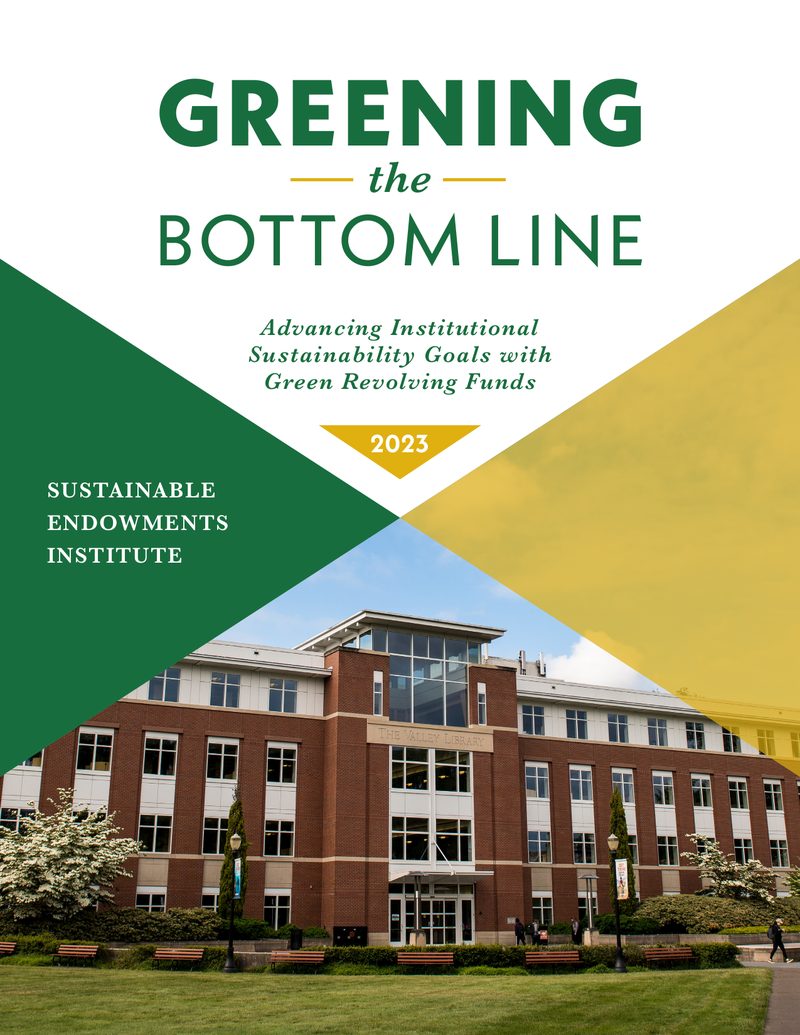
A survey of 66 institutions on how funds are set up and managed, their benefits and the barriers to them. Start here to make the case for a fund.
About the survey -
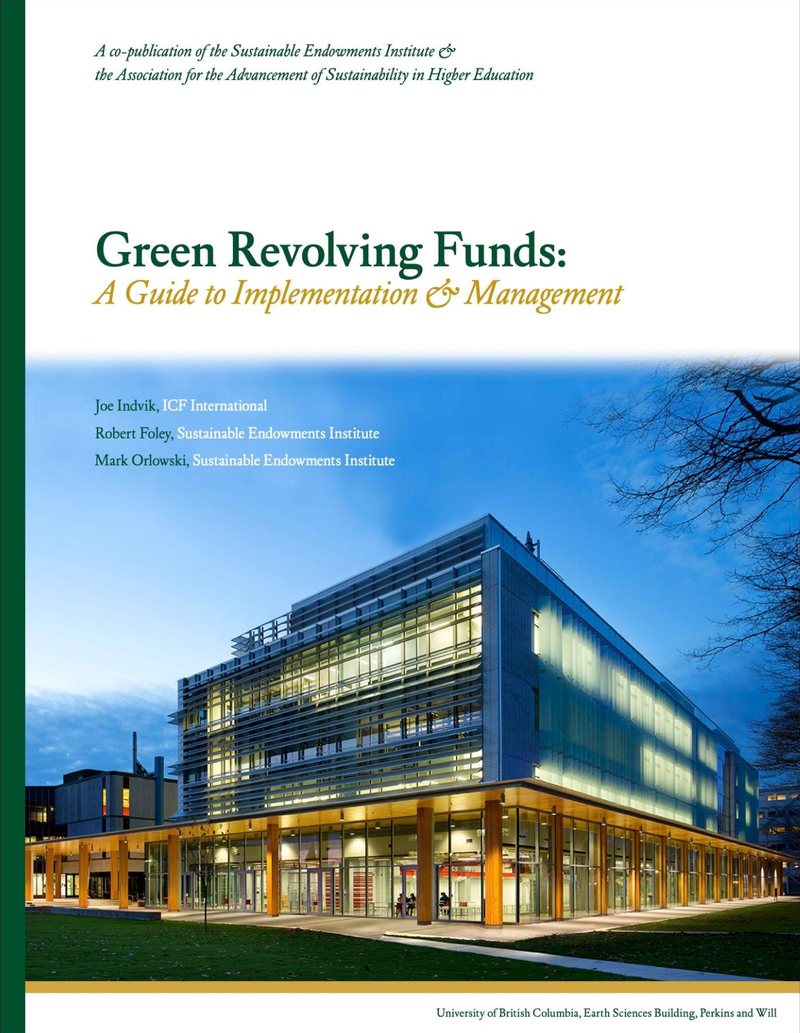
Ten steps to designing, launching and managing a fund, with case studies from Caltech, the University of Vermont and Arizona State. Start here to set one up.
About the guide
Our work has appeared in
All coverage